
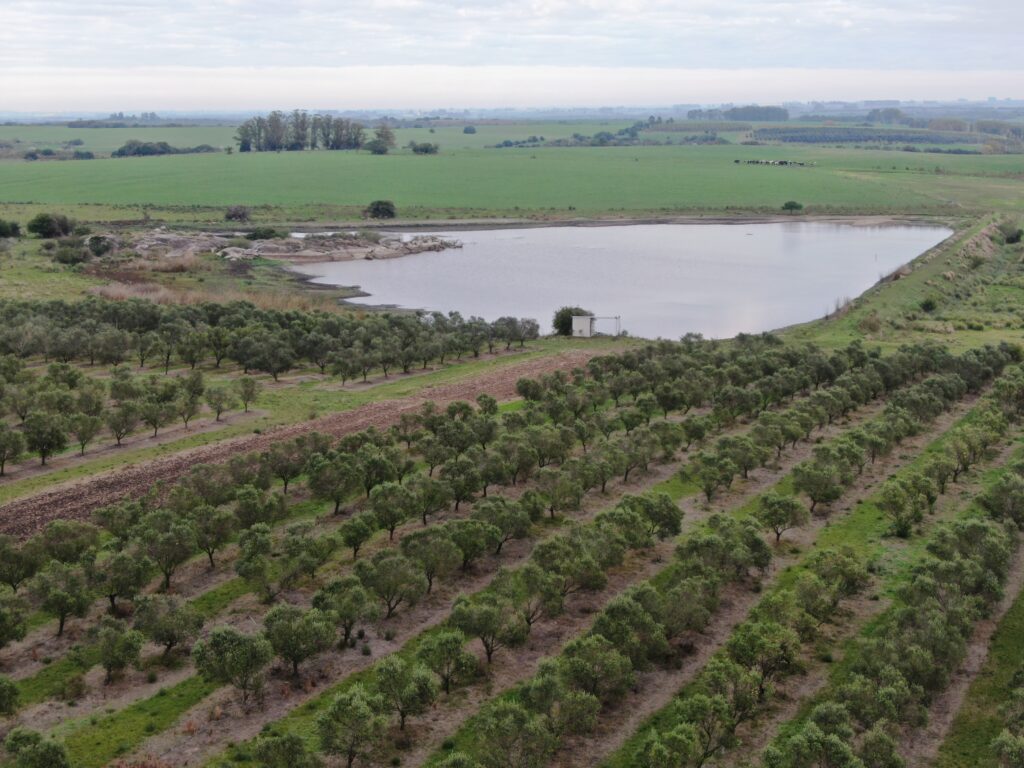
What Makes Farming in Uruguay Stand Out
Uruguay offers one of the most favourable environments for agriculture in Latin America. With roughly 90% of its land suitable for agricultural use, abundant natural resources and a supportive legal & business framework, Uruguay farming presents strong investment potential. U.S. investors interested in farmland will find appealing attributes: global export strength, transparent institutional support, and opportunities for diversified cropping and livestock systems.
Key Data & Facts About Farming in Uruguay
Land and Use
- Uruguay has 16.4 million hectares used for agricultural purposes, covering more than 90% of its territory in terms of suitability and productive potential. XXI
- The agricultural sector (including both farming and livestock) contributes directly about 8% to GDP, and when you include agribusiness (processing, exports etc.), that share rises to 14-16% of GDP.
Employment & Projects
- In 2023, Uruguay’s agriculture and agribusiness sectors supported about 83,500 direct jobs in agricultural activity. XXI
- Between 2020-2023, agribusiness investment projects doubled in number compared to 2016-2019; Uruguay’s Investment Law (Law No. 16.906) helps stimulate these projects.
Exports & Global Role
- In 2023, exports of goods from Uruguay amounted to US$ 11.52 billion. Agricultural-based products are some of the top exports: beef, dairy, rice, and live cattle among them.
- Beef remains one of Uruguay’s most important export items. In 2023, beef exports were valued at about US$2.08 billion, despite volume and price drops vs 2022.

Advantages & Features of Uruguay Farming
Natural & Climatic Resources
Fertile soils, temperate climate, and sufficient rainfall make Uruguay suitable for multiple cropping cycles and pasture. The “agricultural surface” data, soil quality maps, etc., give investors reliable baselines for land productivity.
The country is capable of growing two crops in many areas per year for certain crops depending on the season. Agronomic intensification (e.g. more crop rotation, irrigation where feasible) has been increasing.
Stability & Institutional Support
Uruguay has laws that encourage agribusiness investment, such as Law No. 16.906, which provides incentives.
Government data (through Uruguay XXI) regularly publishes reports and statistics on agriculture, export trade, foreign investment, and sector performance, helping with transparency.
Diversification & Export Markets
Uruguay exports go to many global markets. In 2023, live cattle export (among agricultural-goods) saw strong growth; beef exports remain strong even when affected by external (price/demand) fluctuations.
Beyond beef, key agricultural goods include soybeans, rice, dairy, grains. The export basket is diversified.
How Uruguay Farms Helps Investors Benefit from Uruguay Farming
At UruguayFarms, we guide U.S. investors who want to get involved in Uruguay farming or farming in Uruguay with full support:
Land selection: We identify parcels with good soil (using criteria like CONEAT index), water access, proximity to infrastructure.
Due diligence & legal assistance: Checking titles, legal status, environmental permissions, compliance with export and sanitary regulations.
Market & export strategy: Connecting farms to buyers, helping with certification, assessing demand in U.S., China, EU, etc.
Operational guidance: Advising on crop mix, pasture management, livestock vs cropping combinations, risk management.
About 16.4 million hectares are used for agricultural purposes, and over 90% of the country’s territory is considered suitable for agricultural activity.
The primary sector (crops, livestock, etc.) accounts for around 8% of GDP, and when agribusiness (processing, export linked industries) is included, the contribution rises to 14-16%.
Key agricultural exports include beef, dairy products, rice, soybeans, and live cattle. Beef alone was over US$ 2 billion in export value in 2023.
Important considerations include: variability in commodity prices, climate/weather risk (droughts), ensuring legal and sanitary compliance for exports, infrastructure costs, and logistic access to markets.